Getting Your Quantities Right
One of the most common questions our customers ask is: “How much timber do I need?” Over-order and you’re wasting money on material that sits in the garage. Under-order and your project grinds to a halt while you wait for a top-up delivery.
In this guide, we walk you through the calculation process for the three most common timber applications — cladding, decking and fencing — so you can order with confidence.
Calculating Cladding Quantities
Step 1: Measure Your Walls
For each wall or section to be clad, measure:
- Width in metres (horizontal measurement)
- Height in metres (vertical measurement, or the height of the area to be clad)
- Multiply width × height = area in square metres (m²)
For triangular gable ends, use: (base × height) ÷ 2
Subtract window and door openings larger than 1m² — don’t subtract small windows as the offcuts are rarely usable.
Step 2: Understand Cover Width vs Board Width
This is where most people go wrong. The nominal width of a board is not the same as the cover width (the visible face once installed):
- Tongue and Groove (T&G): A 120mm board typically has a 105-110mm cover width (the tongue is hidden)
- Shiplap: A 150mm board typically has a 125-130mm cover width (overlap is hidden)
- Open Rainscreen: Board width + gap width = spacing. E.g., 20mm board + 10mm gap = one board per 30mm
- Feather Edge: Each board overlaps the next by 25-30mm. A 150mm board has approximately 120mm cover
Step 3: Calculate Board Count
For horizontal cladding:
Number of boards = Wall height ÷ Cover width of board
Then multiply by the number of board lengths needed to span the wall width.
For vertical cladding:
Number of boards = Wall width ÷ Cover width of board
Step 4: Add Waste Allowance
- Simple rectangles: Add 10% for cutting waste and defects
- Walls with windows/doors: Add 15% — there will be more offcuts around openings
- Gable ends and complex shapes: Add 20%
Worked Example
Wall: 6m wide × 3m high = 18m²
Minus one window (1.2m × 1.0m) = 18 – 1.2 = 16.8m²
Using 145mm T&G Siberian Larch (125mm cover):
Boards high: 3000 ÷ 125 = 24 boards
Board length: We’ll use 4m lengths, so need 2 per row (6m width ÷ 4m = 1.5, round up to 2)
Total boards: 24 × 2 = 48 boards
Plus 15% waste: 48 × 1.15 = 55 boards
Order: 55 × 4m boards of 145mm T&G Siberian Larch
Calculating Decking Quantities
Step 1: Measure the Deck Area
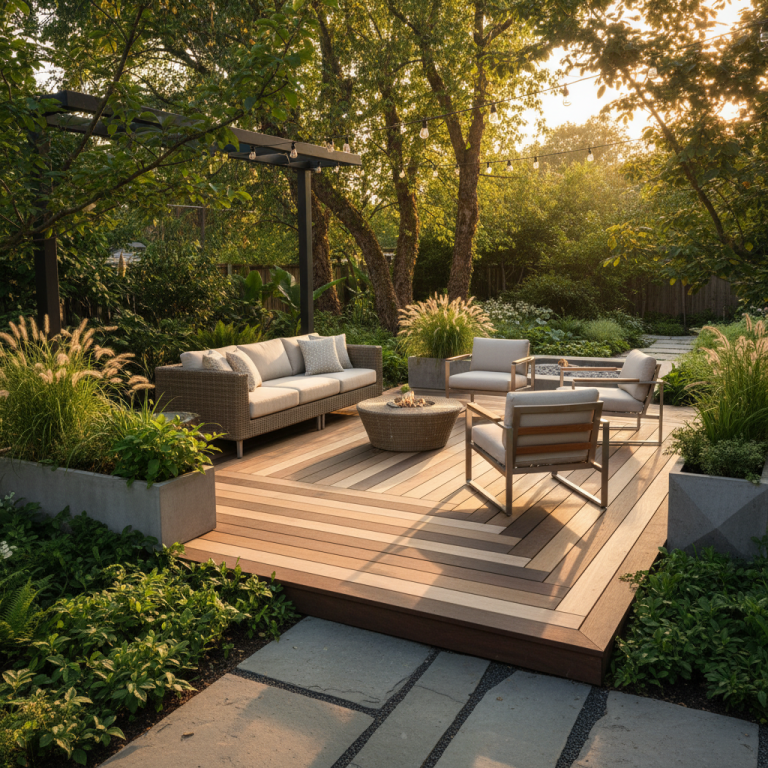
Measure the total area in square metres. For rectangular decks, simply multiply length × width. For L-shapes or irregular areas, break them into rectangles and add together.
Step 2: Calculate Board Count
Standard decking boards are typically 27mm × 145mm (with a 140mm cover width allowing for 5mm spacing between boards).
For boards running along the length:
Number of boards = Deck width ÷ (Board width + Gap) = Width ÷ 0.150m
Each board needs to be at least as long as the deck length (or use multiple boards per row if your deck is longer than standard board lengths).
Step 3: Don’t Forget the Subframe
You’ll also need to order joist timber:
- Joists: Typically 47mm × 150mm treated softwood at 400mm centres (350mm for softwood decking)
- Number of joists: Deck width ÷ 0.4 + 1 (for 400mm centres)
- Joist length: Equal to deck length (or the dimension the joists span)
- Noggins: Add short pieces between joists at 1200mm centres for additional rigidity
Waste Allowance
- Simple rectangle: 10%
- Angled or curved edges: 15-20%
- Diagonal board pattern: 20% (significantly more waste at the edges)
Calculating Fencing Quantities
Step 1: Measure the Run
Measure the total length of fencing required in metres. Note any corners, changes of direction or steps in ground level — each of these will require an additional post.
Step 2: Calculate Posts
Number of posts = Total length ÷ Post spacing + 1
Standard post spacing is 1.8m to 2.4m. For exposed sites or fences over 1.8m high, use 1.8m spacing. For sheltered sites with standard 1.5-1.8m fencing, 2.4m spacing is fine.
Add an extra post for every corner and end point.
Step 3: Calculate Rails
Two rails for fences up to 1.2m high. Three rails for fences 1.5m and above.
Rails per bay = 2 or 3
Total rails = Number of bays × Rails per bay
Step 4: Calculate Boards
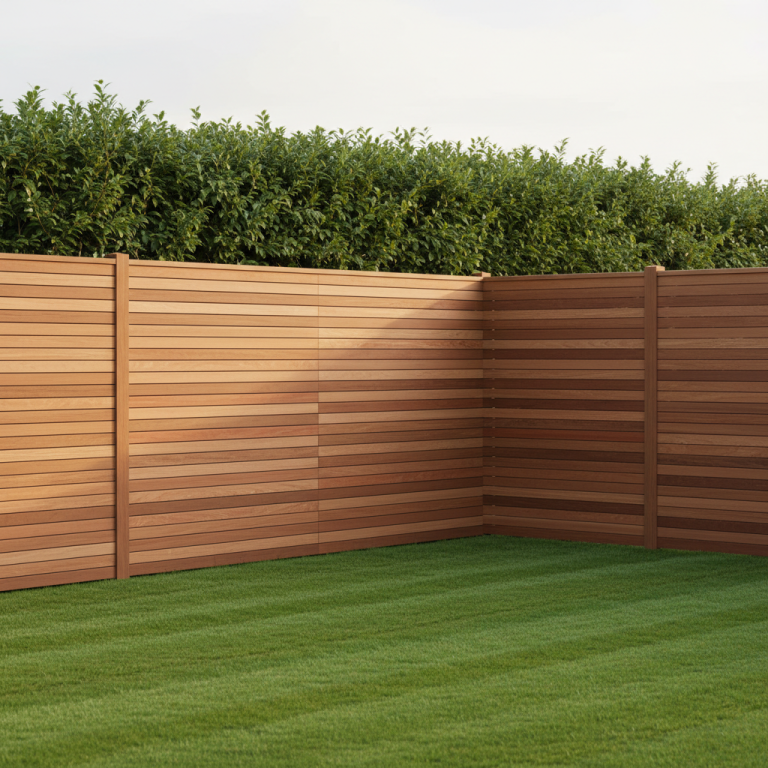
For close-boarded fencing (feather-edge):
Boards per bay = Bay width ÷ (Board width – Overlap)
Example: 1.8m bay with 150mm feather edge boards at 25mm overlap:
1800 ÷ (150 – 25) = 1800 ÷ 125 = 14.4 = 15 boards per bay
For slatted/hit-and-miss:
Boards per bay = Bay width ÷ (Board width + Gap width)
Waste Allowance
Fencing is relatively straightforward — add 5% for defects and cutting waste.
Fixings: How Many Do You Need?
- Cladding screws: Allow 20-25 fixings per square metre of cladding
- Decking screws: Allow 20 fixings per square metre of decking
- Fence nails/screws: 2 fixings per board per rail (i.e., 6 fixings per board for 3-rail fencing)
Need Help Calculating?
If maths isn’t your thing, don’t worry. Send us your measurements (photos are helpful too) and we’ll calculate exact quantities for you, including waste allowance and fixings. We’d rather spend 10 minutes on a calculation than have you order the wrong amount.
Get in touch with your project details and we’ll provide a fully itemised quote with next-day delivery across the UK.